Liberty &
Art Nouveau
The first systematic rebellion against Neoclassicism. Liberty — the Italian name for the movement known as Art Nouveau in France, Jugendstil in Germany and Sezessionsstil in Austria — seeks its forms in nature: sinuous lines like plant stems, floral decoration, symmetry abandoned in favour of organic dynamism. It is the first fully modern bourgeois style.
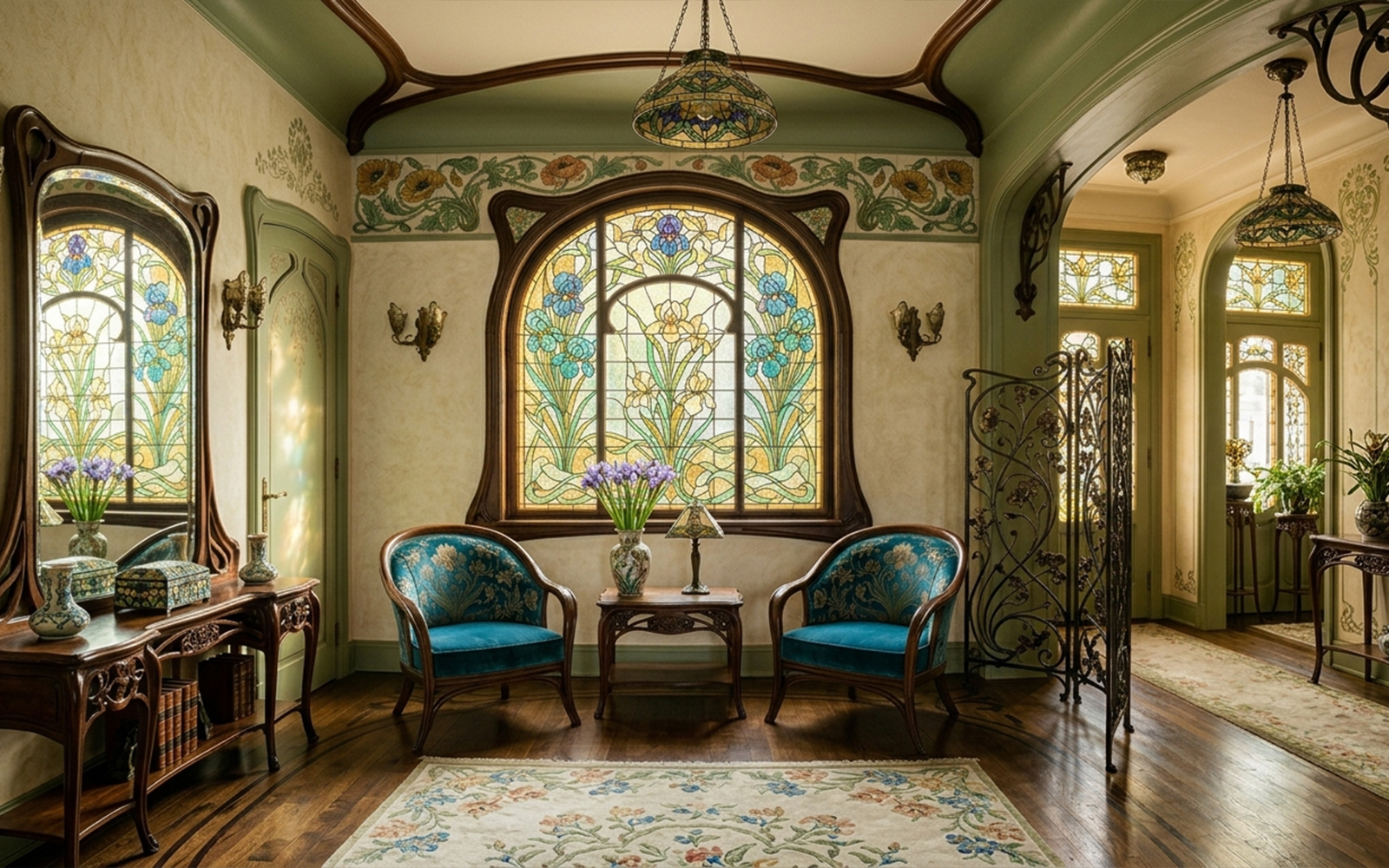
The ornamental repertoire is drawn entirely from nature: iris and wisteria flowers, dragonflies, peacocks, women's hair transforming into waves. Wrought iron is the revelatory material — it allows the fluid curve that no other material of the era could offer. Majolica tiles, Tiffany stained glass and Thonet bent-wood furniture are the iconic objects. The palette is natural and desaturated: moss greens, straw yellow, powder pink, chocolate brown, matt gold. Liberty is also the first style to treat interior design as an integrated discipline: coherence between architecture, furnishings and objects is a requirement, not an option.
"Form follows the flow of life: never rigid, never dead."
— Victor Horta, architect, 1900Prof. Vincenzo Pazzi
Art
Déco
The glamour of the interwar years. Art Déco was born in Paris in 1925 (International Exhibition of Decorative Arts) and conquered the world within a few years. It responds to Liberty with geometry: where the latter curved, this angulates. Chevrons, fans, sunrays, zigzags. It is a style of democratised luxury — expensive but not aristocratic, modern but not industrial.
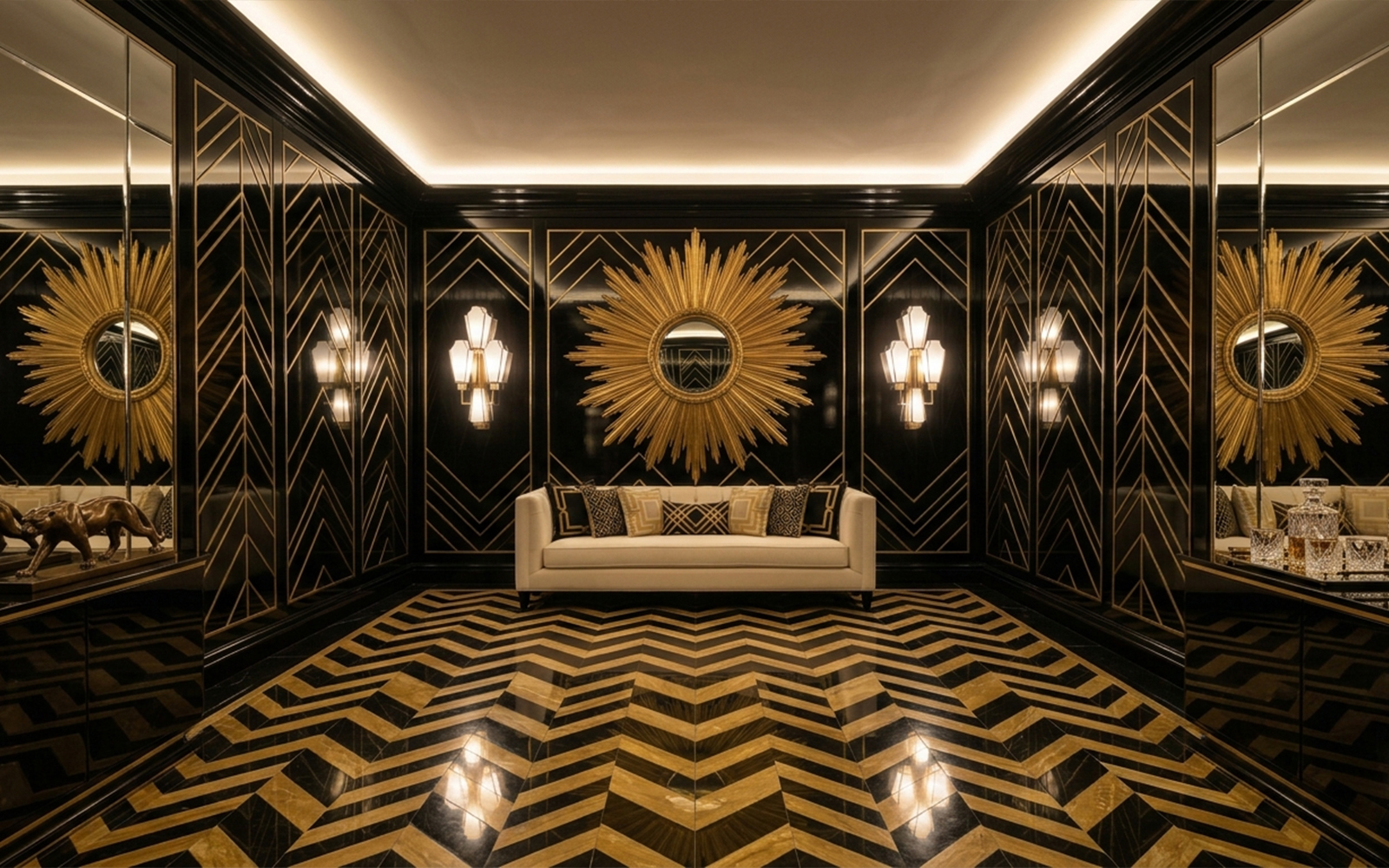
The formal vocabulary is geometric and reduced: zigzags, chevrons, sunrays, fans. The contrasts are strong and deliberate: black and gold, ivory and red lacquer, white marble and brass. Noble materials are used without restraint: high-gloss lacquers, exotic leathers, chrome brass, black Marquina marble. Art Déco is a style of ostentatious yet disciplined luxury: every element is precise, every pairing is calculated. Its impact on contemporary interior design is enormous — the New Luxury of the 2010s and 2020s owes a great deal to its geometric and material vocabulary.
"Luxury must be comfortable, otherwise it is not luxury."
— Coco ChanelProf. Vincenzo Pazzi
Rationalism &
Bauhaus
The most radical revolution in design history. The Bauhaus school — founded by Walter Gropius in Weimar in 1919 — proposes a simple yet explosive idea: form must be determined by function, not by ornament. Furniture must be mass-producible, accessible to all, honest in its materials. The result is the style that founded modern design as a discipline.
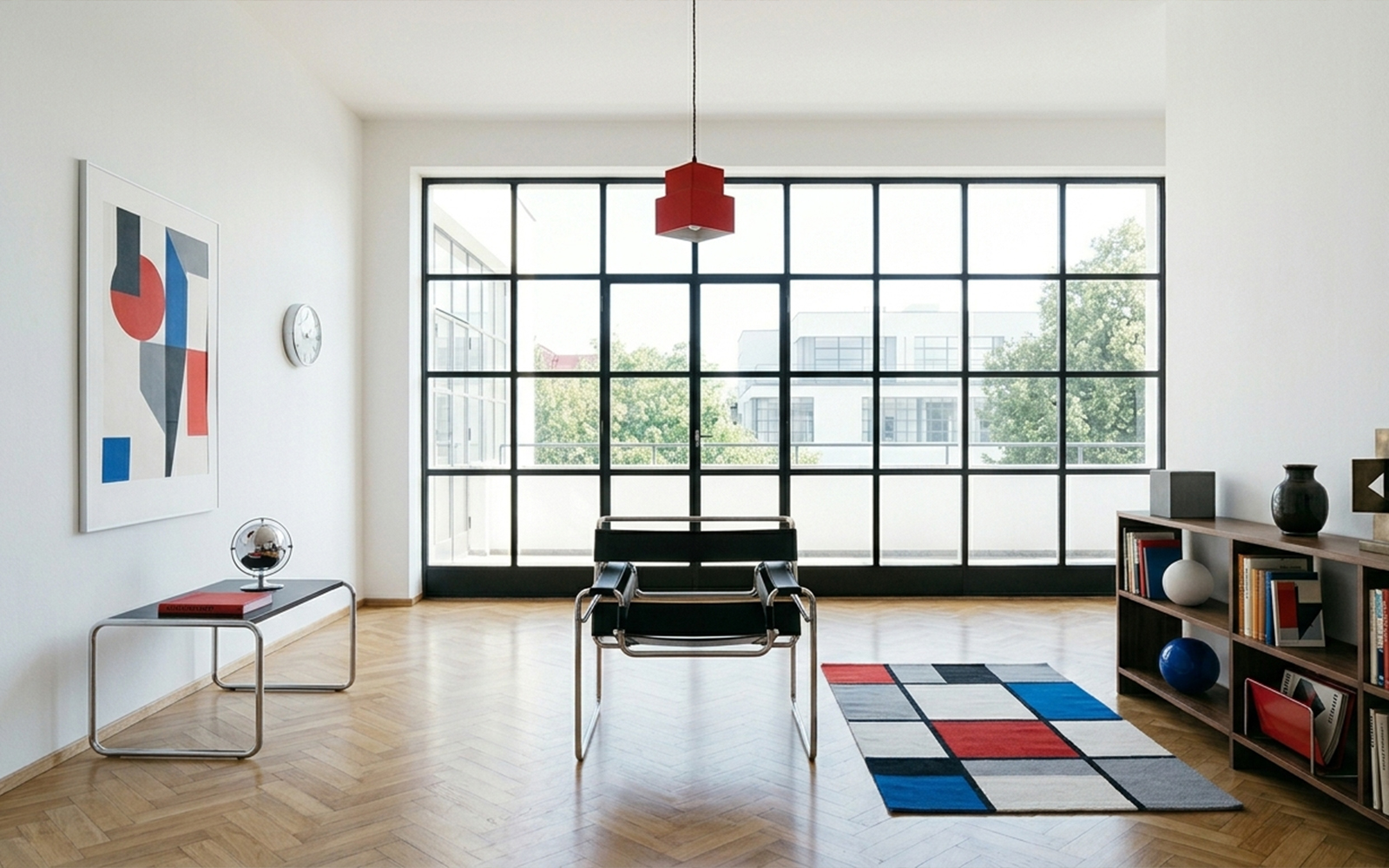
The chromed steel tube — invented by Marcel Breuer — is the symbol of the Bauhaus: industrial, honest in its materials, reproducible in series. Bent plywood, plate glass and exposed concrete are equally central. The palette is reduced to the essentials: white, grey, black, and the three primary colours as accents. Every object must answer the question: "why does it exist?". The Bauhaus did not survive Nazism as an institution — closed in 1933 — but its masters (Mies van der Rohe, László Moholy-Nagy, Josef Albers) brought its teaching to the USA, where it founded American modern design.
"The ultimate goal of all creative activity is building."
— Walter Gropius, Bauhaus Manifesto, 1919Prof. Vincenzo Pazzi
Mid-Century
Modern
The post-war American style: optimism, industrial production, organic forms. Born in the United States between the 1940s and 1960s as a response to the prosperity of the economic boom, it inherits the rationality of the Bauhaus but softens it with gentle curves, warm woods and vivid colours. Charles and Ray Eames, Eero Saarinen, Harry Bertoia: its protagonists are still the most cited designers in the world today.
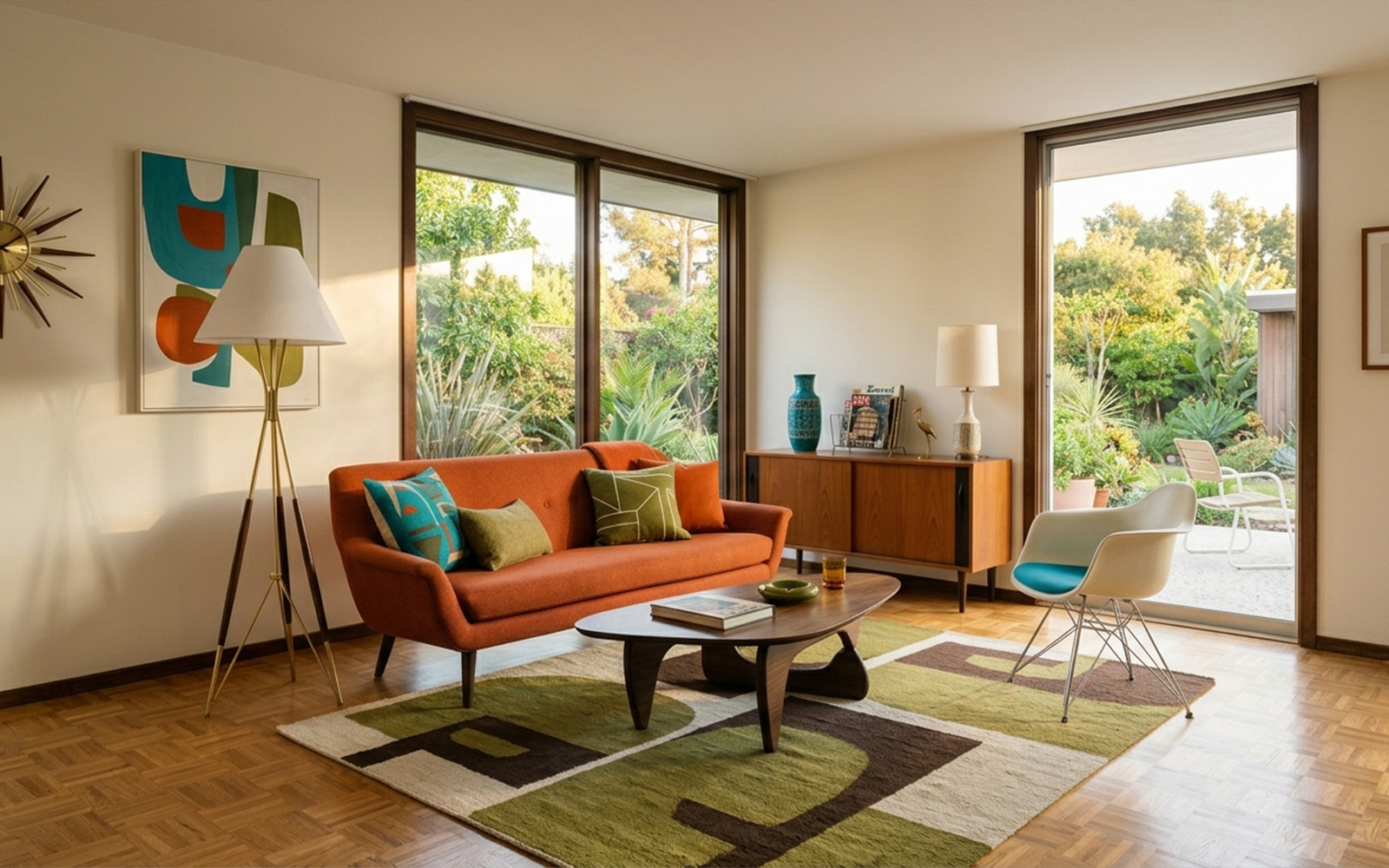
The bent plywood of Charles and Ray Eames, the tapered legs of Scandinavian-influenced furniture, low-slung sofas with thick cushions, walnut sideboards with sliding doors: these are the objects that define MCM. The indoor-outdoor connection is a design principle: large glazed walls, floors that continue towards the garden, potted plants everywhere. The colours are warm and vivid — turquoise, burnt orange, olive green, mustard yellow — on a neutral base of walnut wood and white. No historical style is revived as comprehensively as MCM in recent decades: its contemporary popularity is simply unstoppable.
"It is not necessary to create something new: one must discover what already exists."
— Charles Eames, designerProf. Vincenzo Pazzi