Industrial
& Loft
Born from the conversion of disused production spaces in post-industrial cities: New York, Berlin, Milan, Manchester. Designers inhabiting former factories and warehouses do not conceal the structures — they display them. Exposed steel beams, bare brick walls, conduits on the ceiling, concrete floors: what was functional becomes aesthetic. The Industrial style is a celebration of structural honesty.
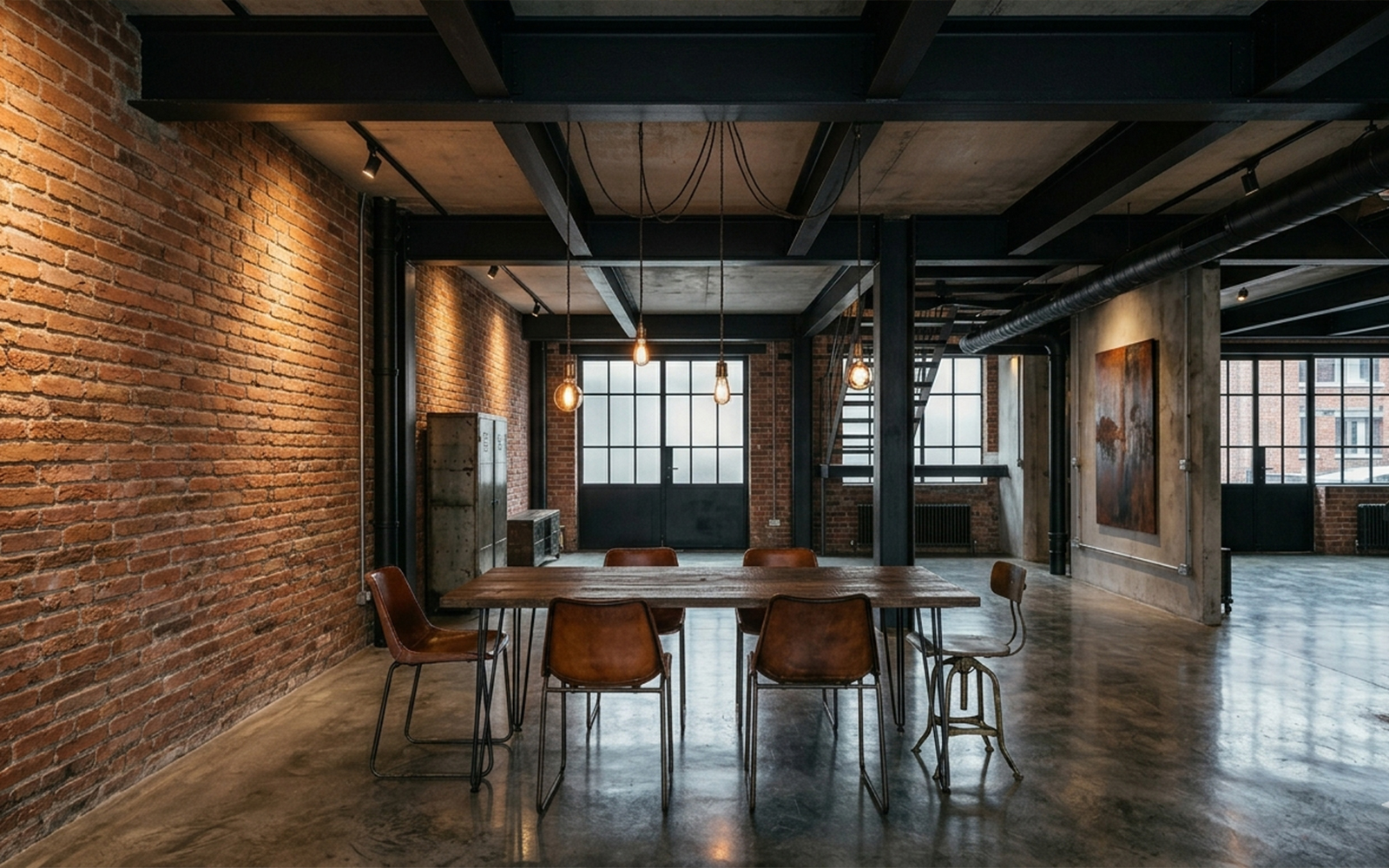
The materials are "honest" in the Bauhaus sense of the word, but applied at an urban scale and with a deliberately raw aesthetic: bare unplastered brick, IPE steel beams, exposed air ducts, unfinished concrete. The wood is rough or reclaimed, with prominent knots and grain. Aged leather, workshop stools repurposed as chairs, factory-style pendants: every object carries the history of manual labour. The colour palette is chromatically restrained — concrete grey, black, rust, dirty white — yet texturally very rich. The most common mistake is turning Industrial into a catalogue aesthetic, losing its authenticity in the process.
"Beauty does not lie in concealing the structures — it lies in showing that one knows how to build well."
— Renzo Piano, architectRustrial is the fusion of Rustic and Industrial — a term that has gained currency in the residential market to describe spaces that combine the raw materials of the Industrial style (steel, concrete, exposed brick) with the warmth and organic textures of rural, rustic interiors (rough-hewn timber, natural stone, hand-thrown ceramics). It is not an autonomous style with its own design philosophy, but a mix that is widely requested and commercially successful, particularly in the renovation of rural properties and farmhouses.
Prof. Vincenzo Pazzi
Bohemian
& Eclectic
The style of the artist, the traveller, the collector. Bohemian respects no other style's rules — it incorporates them all, selectively, following the thread of the personal biography of whoever inhabits the space. It is the most difficult style to design: it appears anarchic but requires a deep coherence that is not visual but emotional and narrative. Without that coherence, it simply becomes disorder. Its contemporary, more curated interpretation — in which the palette is tighter and the objects are more carefully edited — is widely known as Boho Chic.
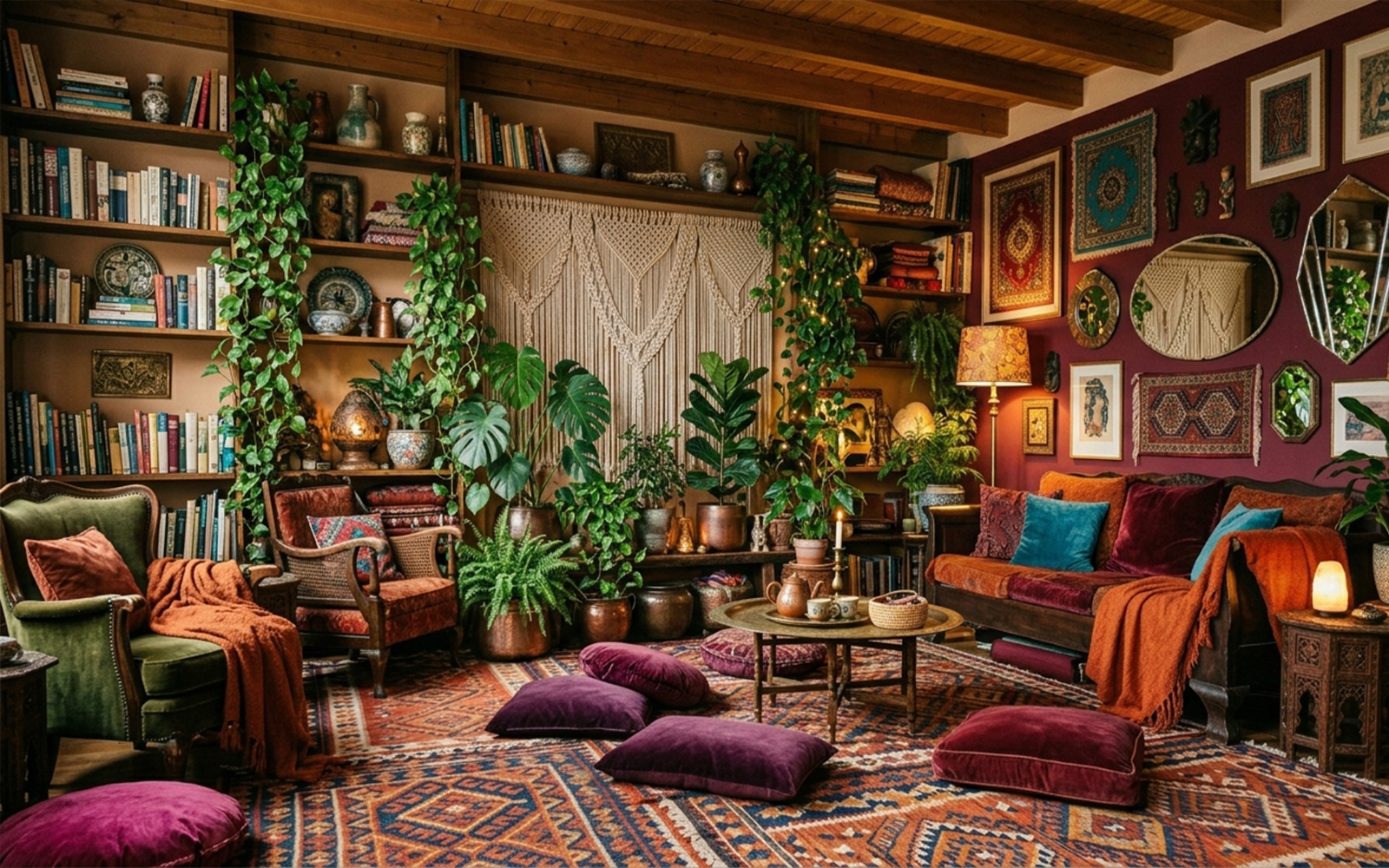
Bohemian works when there is a hidden common denominator that justifies the mix: usually it is chromatic warmth (all tones are warm, saturated, earthy) or the artisanal quality of the objects (everything is handmade or has a story). Layered Turkish kilim rugs, Indian ikat cushions, Mexican ceramics, Moroccan perforated brass lanterns, plants everywhere. The palette is rich and saturated but coherent: bordeaux, burnt orange, turquoise, ochre, deep green. The typical mistake is adding without selecting — authentic Bohemian is curated, not chaotic.
"A room tells the story of whoever lives in it. If that story is interesting, the room is beautiful."
— Ilse Crawford, designerEclectic is often used as a synonym for Bohemian, but the distinction is worth making. Bohemian is autobiographical: it draws from travel, collecting, personal history. Eclectic is curatorial: it deliberately selects elements from different historical styles — a Baroque mirror, a Mid-Century chair, a contemporary artwork — and combines them according to formal criteria (proportion, colour, material quality) rather than personal narrative. Eclectic requires design knowledge; Bohemian requires life experience. Both can produce extraordinary interiors when executed with intention.
Prof. Vincenzo Pazzi
Tropical
& Biophilic
Biophilic Design is not a trend — it is a scientific response to a fundamental human need. Research shows that visual contact with nature reduces stress, improves concentration and increases wellbeing. Tropical is its most exuberant expression: abundant greenery, natural materials, filtered light, organic forms. Its domestic, apartment-scale version — with potted plants as the primary design tool — is widely known as Urban Jungle. This is not about bringing plants indoors — it is about redesigning the interior as an ecosystem.
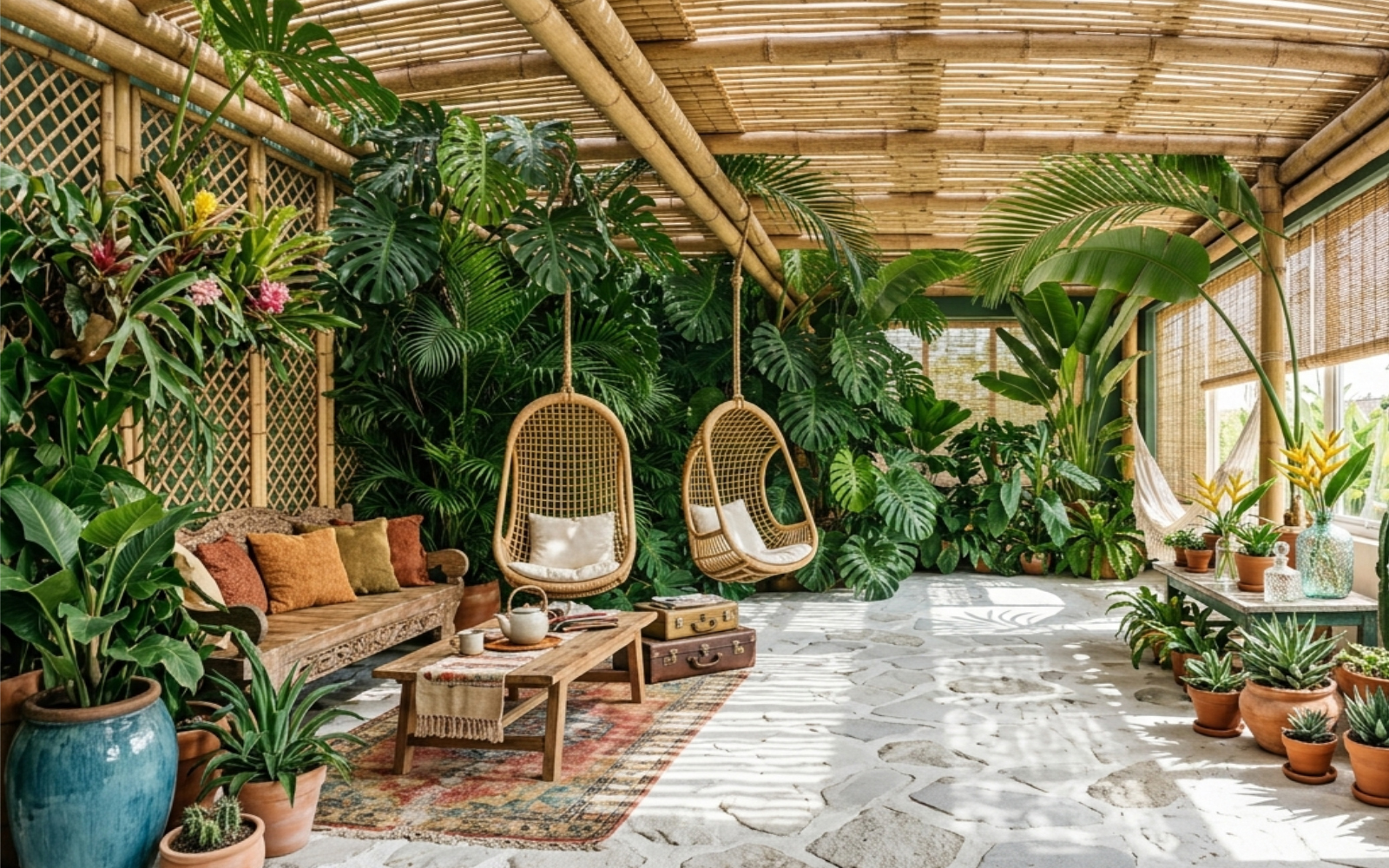
Plants are not decorative accessories here — they are structural elements of the project. Biophilic design considers zenithal natural light, living walls, indoor water features and materials that respond to humidity. In contemporary Tropical, monstera leaves and potted palms coexist with rattan, bamboo, light teak and white cotton. The colours are those of the rainforest: deep tropical green, bright white, terracotta, lemon yellow as an accent. Biophilic design is not an aesthetic choice — it is a wellbeing choice backed by data on stress reduction and productivity gains.
"Human beings have a deep need to connect with other life forms. It is in our DNA."
— E. O. Wilson, biologist, theory of biophilia, 1984Prof. Vincenzo Pazzi
Maximalism
& New Luxury
The reaction to Minimalism. Contemporary Maximalism is not a poor man's Baroque: it is a conscious political and cultural choice. "More is more" does not mean "everything together" — it means that every addition is deliberate, every layer has a role, every colour is justified. New Luxury carries this philosophy towards absolute material quality: nothing is compromised, every element is the best in its category.
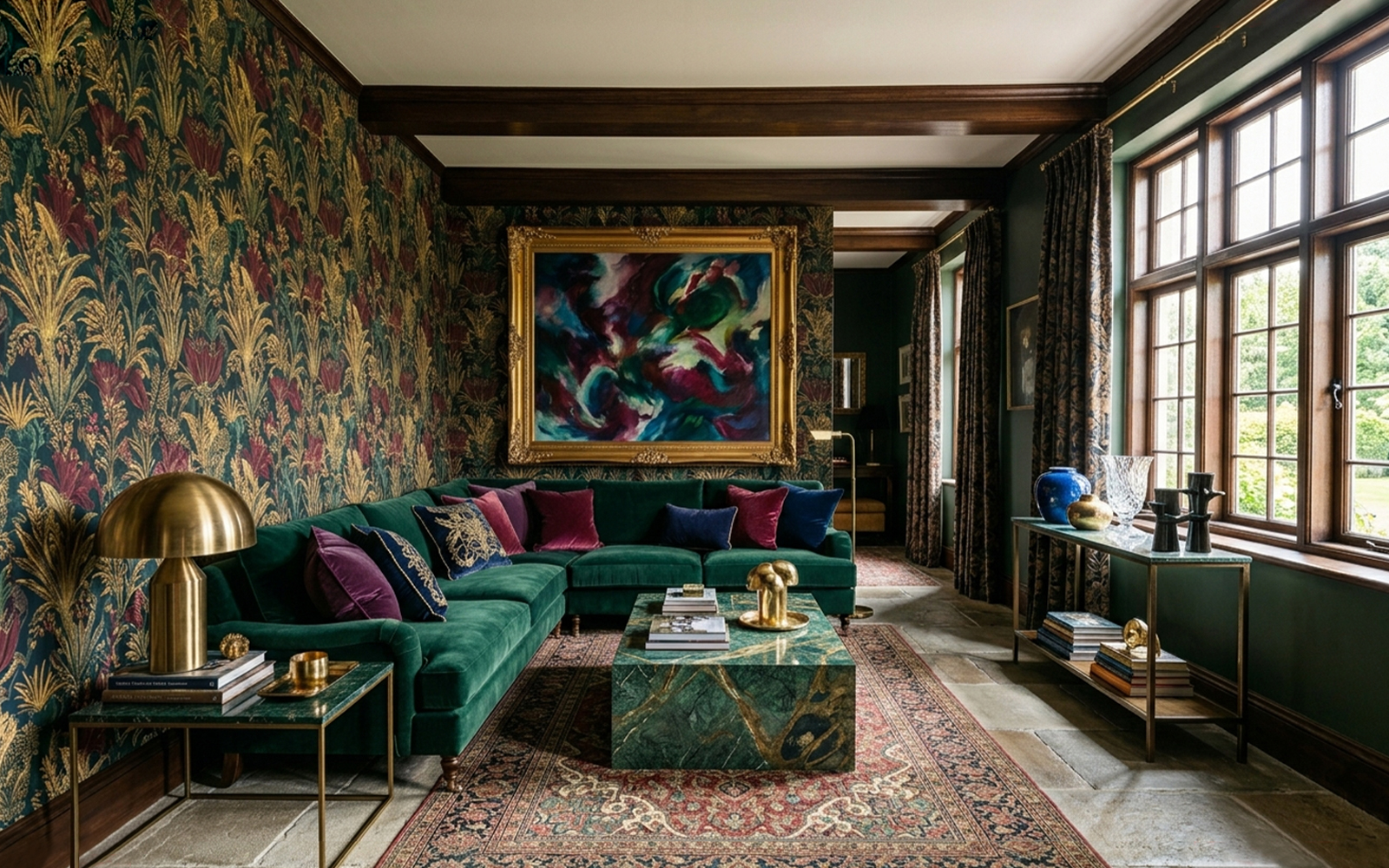
New Luxury is not a revisited Baroque — it is the aesthetic of elevated material quality, deep and saturated colours, surfaces with a decisive character. Printed wallpaper with botanical or sophisticated geometric motifs, velvets in midnight blues and deep bordeaux, golden brass for hardware and lighting, marble with a prominent veining. The palette is rich and dark — midnight blue, bottle green, bordeaux, gold, ivory — and every tone is fully saturated. The risk is cacophony; the solution is chromatic hierarchy: one colour dominates (60%), one supports (30%), one accents (10%). Maximalism demands more design skill than Minimalism, not less.
"Luxury is what you notice afterwards — not what you see immediately."
— Axel Vervoordt, interior designerProf. Vincenzo Pazzi