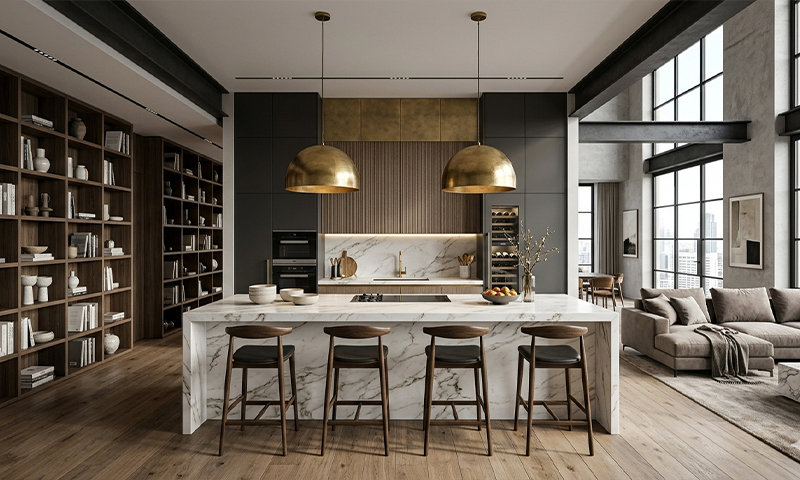
Strapazzi.com Homepage
Chapters
01
Fundamentals
Why · Objectives · History · Typologies · System · Budget
02
Ergonomics & Spaces
Triangle · Zones · Sequence · Heights · Spaces · Worktop · Accessibility
03
Configurations
Linear · Double · L · U · Island · Peninsula
04
Systems & Lighting
Plumbing · Gas/Induction · Hood · Outlets · Lighting · Regulations
05
Materials & Design
Materials · Worktops · Doors · Interior systems · Optimisation · Phases
01
Chapter 01

Fundamentals

The kitchen as the fundamental room of the home: history, typologies, integrated system and budget planning.

Fundamentals

Why Design
a Kitchen

The kitchen is the fundamental room of the home

A well-designed kitchen has a profound impact on daily wellbeing. It is not a simple assembly of furniture, but a complex system that integrates technology, aesthetics and human behaviour. In an average family, more than 3 hours a day are spent in the kitchen: every design error is paid for every single day for years.

01 It is one of the most complex rooms in the entire home
02 It simultaneously integrates systems, ergonomics and design
03 It must be functional, safe and durable over time
04 It directly influences comfort and quality of life

Prof. Vincenzo Pazzi

Objectives

Objectives of
Design

Functionality and balance between use and aesthetics

A well-designed kitchen is never the result of chance. Every choice responds to precise criteria that determine the quality of the daily experience. The designer must balance the needs of the user with the technical and architectural constraints of the space.

1Functional — every element has a precise role
2Ergonomic — sized for the human body
3Safe — compliant systems, certified materials
4Aesthetically coherent with the rest of the home
5Easy to clean, maintain and repair over time

Prof. Vincenzo Pazzi

History

The Evolution
of the Kitchen

From service room to heart of the home

The modern kitchen is the result of a centuries-long evolution. Understanding its history helps to grasp the design principles we use today and the directions in which the sector is evolving.

Until 1800

The separate kitchen

A service environment, confined to the lower floors. The open fire as the only cooking system. No ergonomic design, space governed by domestic staff.

1926

The Frankfurter Küche

Margarete Schütte-Lihotzky designs the first rational kitchen: 1.9×3.4 m, every centimetre optimised. It is the mother of the modern fitted kitchen, inspired by an ocean liner cabin.

1950 — 1970

The Italian fitted kitchen

Snaidero, Scavolini, Aran revolutionise the market with interchangeable standard modules. The kitchen is born as a democratic industrial product: beautiful, accessible, modular.

1980 — 1990

Design enters the kitchen

Boffi, Varenna, Bulthaup elevate the kitchen to a design object. Aesthetics become the primary design parameter. The concept of "lifestyle" applied to the kitchen is born.

From 2000 to today

Open kitchen and living kitchen

The kitchen opens onto the living room and becomes a social space. The island transforms the cook into a social protagonist. Smart technology enters appliances. The kitchen/living boundary disappears.
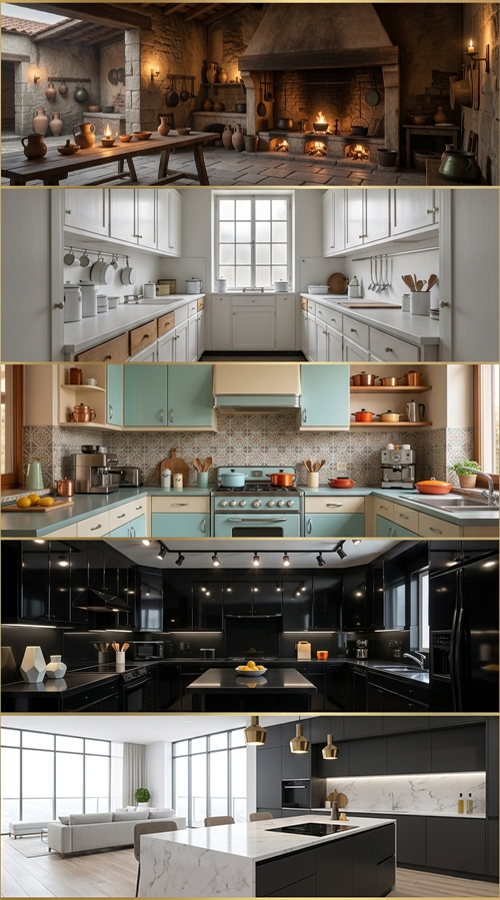
Evoluzione cucina

Prof. Vincenzo Pazzi

Architecture

Kitchen
Typologies

The choice of architectural type conditions the entire project

Even before thinking about furniture configurations, it is necessary to decide the architectural type of kitchen. This choice determines the relationship with the other spaces in the home, sociality, ventilation and system requirements.

Cucina chiusa
Type 01
Closed Kitchen

Completely separate room with door. The traditional Italian and French model. Separates the preparation area from the living space, isolates smells and noise. Ideal for those who love to cook in complete autonomy.

✓ Smells contained✓ Total privacy✓ More effective hood
✗ Social isolation✗ Perceived smaller space
Cucina aperta
Type 02
Open Kitchen

Fully integrated into the living room, without physical barriers. The dominant model of the last 20 years. The cook is the protagonist of the social space. Requires great aesthetic care and a very efficient range hood.

✓ Maximum sociality✓ Brightness✓ Perceived spacious
✗ Smells in the living room✗ Always tidy
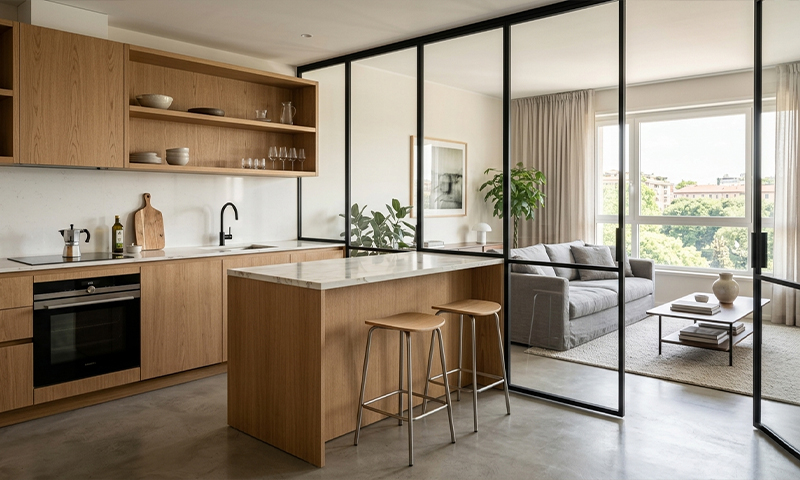
Cucina semi-aperta
Type 03
Semi-Open Kitchen

Visually connected to the living space but with partial separation: peninsula, low partition, level difference or sliding glazing. The most versatile compromise solution, suitable for most medium-sized homes.

✓ Functional balance✓ Flexibility✓ Partial privacy
✗ More complex design
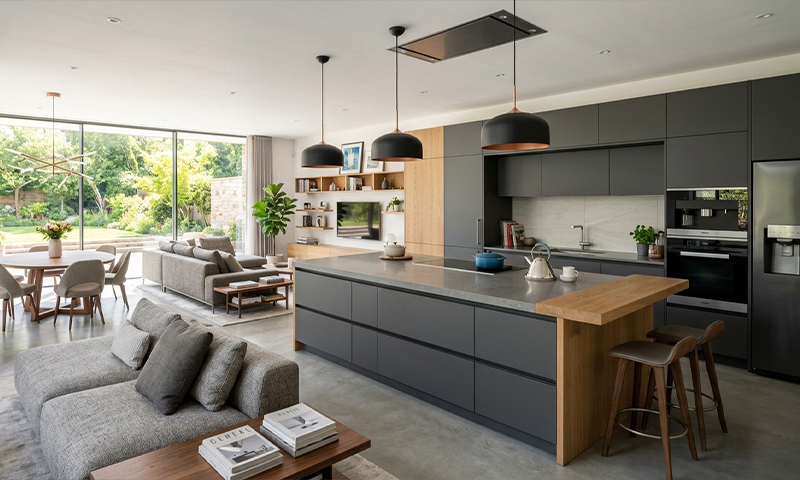
Living kitchen
Type 04
Living Kitchen

The kitchen is the focal point of the living space: large central island, integrated sofa, bookcases. The model for large homes and high-level contemporary design. Requires at least 30 m² and a significant investment.

✓ Architectural statement✓ Maximum conviviality✓ Adds property value
✗ Abundant space required✗ High budget

Prof. Vincenzo Pazzi

Methodology

The Kitchen as an
Integrated System

Three dimensions that must work in harmony

The most common mistake is approaching kitchen design as a sequence of independent choices. In reality every decision impacts all the others. An experienced designer always works on three levels simultaneously, maintaining a vision of the overall system.

⚙️
Function

The kitchen must work perfectly: ergonomics, work triangle, access to systems, sufficient storage, washable surfaces. Function is the non-negotiable requirement. It is the foundation.

Aesthetics

The kitchen must be beautiful and coherent with the language of the home: materials, colours, finishes, proportions. Aesthetics is not a luxury but contributes to daily psychological wellbeing.

🔌
Technology

Systems, appliances, opening mechanisms, lighting, smart solutions. Technology amplifies function and aesthetics when integrated from the outset. It becomes a problem when added as an afterthought.

Key principle

The correct hierarchy is always: function first, then aesthetics, then technology. A beautiful but uncomfortable kitchen is a design failure. A technologically advanced but poorly organised kitchen is an equal failure. Function is the foundation on which everything else is built.

Prof. Vincenzo Pazzi

Economics

Budget
Planning

Investing wisely is first and foremost a design choice

The budget determines the design possibilities, but does not guarantee the result on its own. A well-designed €8,000 kitchen surpasses a poorly planned €30,000 one. Correct budget allocation is an integral part of the project, not a footnote.

Recommended average allocation

Furniture and structure35–45%
Appliances20–30%
Worktop10–15%
Systems and works10–20%
Dedicated lighting5–10%
Contingency10%
Never cut on structural systems and works. Saving €500 on plumbing can cost €3,000 in damages in the first five years. Investing in the structure and saving on finishes is always the correct choice.

Investment ranges

Entry Level5.000 – 12.000 €

Standard fitted kitchens with good functional performance, standard finishes, mid-range appliances. Suitable for renters or those with a limited budget.

Mid Range12.000 – 30.000 €

Better construction quality, customisable finishes, branded appliances, quartz or stone worktop, quality interior systems. The most common range on the Italian market.

High End30.000 – 80.000 €

Design kitchens, premium materials (solid wood, natural stone), premium appliances, partially bespoke production, lacquered or metallic finishes.

Bespoke / Luxury80.000 €+

Every element designed and made specifically. Rare marbles, precious metals, exotic woods. Brands: Boffi, Poliform, Arclinea, Bulthaup. Dedicated designer included.

Prof. Vincenzo Pazzi